Paper in the Digital Age
There are literally thousands of technologies that have changed the way humans live. We use our smartphones to read news or books. We can communicate on social media. We are able to do our banking transactions online. People are even going paperless in today’s digital age. However we are still buried in paper. It turns out that before we stop relying on this essential human product, a long way must yet be traversed.
Businessweek projected that paper would be extinct by 1990 as computers changed the business environment. Nevertheless, more than 25 years later, since it was predicted in 1975, we are still producing more paper than ever. The main barrier to that transformation is inertia. It is a tendency of all physical objects to resist changes in their state of motion. Simply said, people tend to act in the same way they always have because familiarity makes life simpler for short periods of time. The majority of procedures used today, from filling out birth documents in the hospital to applying for a loan, were initially developed using pen and ink. The issue is that simply digitizing paper-based procedures is insufficient justification for making the changeover.
Paper is widely used, affordable, and accessible. In just 15 seconds, more than 199 tons of paper had already been produced. This high count comes from high demand because it works for a variety of tasks, including writing, printing, packaging, and wrapping. As a result, there is still a stunning quantity of paper waste produced, and 25% of it ends up in landfills. While paper decomposes in landfills, it creates methane, a greenhouse gas with 25 times the ability to trap heat as carbon dioxide. This is not only a tragedy for the environment but also proof of inefficiency because most of us are not aware of the intelligence and insight it requires to prosper from a tiny piece of paper.
The Journey of a Tiny Piece of Paper
The main impact of our mindless use of paper is deforestation. The World Wildlife Fund (WWF) estimates that paper contributes to around 10% of worldwide deforestation. In all forest types combined, 386 million hectares of forest were lost globally between 2001 and 2019. In this case, to supply the pulp and paper business, huge areas of rainforest have been cleared.
Cutting down trees to produce a single piece of paper is a complex procedure. In general, the most valuable trees are cut down first. Following the clearing of the forest, the leftover trees are taken to a mill, where they are chipped into pulp that is either exported or used for producing paper. While energy is required to produce everything, paper production requires twice as much energy as plastic bags do and consumes a lot of water as well.
Without even mentioning the 300 million people who make forests their home worldwide, forests everywhere offer carbon sequestration, defense against floods, landslides, and soil erosion, as well as a rich biodiversity of plants and animals and the raw ingredients for medicines. If we are still mindlessly self-indulgent in using paper, then we ourselves can clearly think: “It is not worth it to destroy our earth just to make a tiny piece of paper to write something”.
One ton of recycled paper could save 17 trees, which can each absorb 250 pounds of carbon dioxide every year. However, burning that same ton of paper would create 1,500 pounds of carbon dioxide.
Upcycle vs Recycle
Fortunately, many people are already driven to act responsibly toward our planet as environmental issues gain global attention. Recycling and upcycling are now efforts to uplift the quality of a lifestyle that prioritizes sustainability. According to a recent survey, 59% of respondents stated they feel better about their waste-generating behaviors when they buy products made of recyclable materials. While three out of five respondents stated that they always make an effort to reuse or upcycle products. Then, what is the difference between these two terms?
Upcycling and recycling are not the same thing, despite seeming similar. Upcycling is a way of repurposing old things without dismantling the original item. Such as looking for ideas for paper upcycling to be a craft to ensure we get the most out of the materials. Therefore, it is also known as “creative reuse” due to its modified function or improved value, as commonly described.
Meanwhile, recycling is the act of classifying and processing waste in order to reuse materials in their current condition to create something new. This idea places value on the resources used to give second life to the products and follows a cyclical paradigm of use → recycle → reuse. It upholds the regrettable societal standard that something can be thrown away after one use. Contrary to upcycling, the breakdown of materials in a recycling system usually produces a lot of emissions. In these circumstances, upcycling emerges as a far more enticing and sustainable choice.
 Credit: https://www.paperone.com/
Sustainable Living with Royal Golden Eagle (RGE)
Wood, the primary raw material for paper, has the potential to be a resource that is really renewable and sustainable with the right management and rules. While, technological advancements have made it possible to produce something in efficient ways. Thus, the Royal Golden Eagle (RGE) group of companies, through Asia Pacific Resources International Limited (APRIL) became one of the largest, most technologically advanced, and most efficient makers of pulp and paper products in the world. As part of their 5Cs business concept, their aim is that whatever they do must be beneficial to the community, the country, the climate, and the customer before it can be beneficial to the company.
APRIL Group is a leading producer of fiber, pulp, and paper with forestry plantations and manufacturing facilities on the Indonesian island of Sumatra. They are in charge of managing 1,046,894 hectares of land concessions. That big responsibility leads them to use a production-protection approach. Through their 1-1 commitment, they pledge that for every hectare of planting that the corporation develops, one acre will conserve natural forest area. This commitment is manifested through the Restorasi Ekostem Riau (RER) Program, a collaborative project to restore and conserve peat swamp forests as ecologically important high conservation areas in Indonesia. It is located in two landscapes on Sumatra’s eastern coastline: Kampar Peninsula and Padang Island in the Province of Riau. With this commitment, APRIL demonstrates their ambitious stance on sustainable living. They attempt to mitigate the impacts of deforestation and save the environment for future generations.
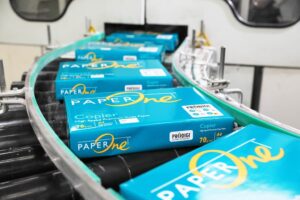
Millions of people use items from the APRIL Group every day, including magazines, books, tissues, shopping bags, food packaging, and liquid packaging. One of the most renowned products from APRIL is PaperOne, which is PEFC certified (Programme for the Endorsement of Forest Certification), ensuring that paper is sourced from controlled and sustainably managed sources. Since they implemented lean manufacturing concepts, a production process that constantly aims to reduce waste, their mill operations are becoming more efficient, especially in terms of how they use energy and water, as well as how much greenhouse gas they emit. Because they consistently produce professional-quality prints with minimal impact on the environment, more than 110 nations sell their product. Also, they ensured that PaperOne carton boxes would be reusable, ergonomic, and lightweight.
So, what can we do to keep our earth green? One simple small step we can take is to use eco-friendly and sustainably made products. By considering the products we use carefully, we can be more ethical consumers. So, to be more environmentally friendly, look for paper products made from sustainable materials from sustainable manufacturers, such as PaperOne. Last but not least, beside from being able to paper upcycling, we can also upcycle PaperOne carton boxes into creative things, such as letter trays, magazine holders, and storage racks by this video #OneBoxChallenge.